Case studies
We have built a reputation on successfully completing challenging projects, from major commercial contracts to domestic and residential sites. See below a range of these completed projects.

Home » Case Studies
We have built a reputation on successfully completing challenging projects, from major commercial contracts to domestic and residential sites. See below a range of these completed projects.
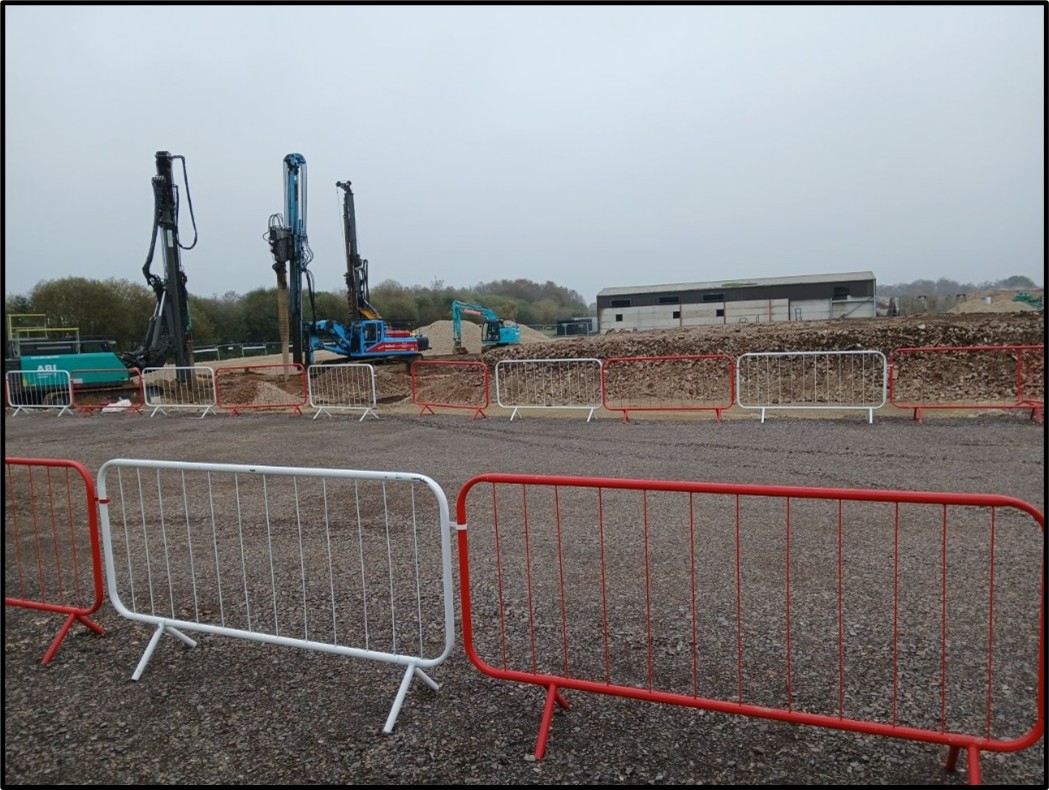
As part of a new energy from waste facility, our client was contracted to form foundation bases for several bulk storage structures, including a series of 29.0m diameter tanks applying a peak bearing pressure of 130kPa to the supporting soils.
A maximum permissible total slab settlement of 35mm was specified, alongside a maximum specified angular distortion criterion.
The shallow soils comprised up to 5.0m of Firm to Stiff Clay Fill, over Medium Dense to Dense Sand of the Branksome Sand formation.
Adopting a high area replacement ratio for vibro replacement stone columns installed full depth through the Clay Fill, our estimated tank settlement under an applied bearing pressure of 130kPa was 46.6mm.
Options to limit tank settlements to within tolerable limits included reverting to a traditional piled approach, the use of rigid inclusion ground improvement, or vibro stone columns with pre-consolidation using static surcharge.
A sufficiently large stock of aggregates was available on site to facilitate static surcharging, and this was selected as the most cost-effective method for achieving a satisfactory design solution.
Using GeMech’s in-house ground improvement design process, a settlement of 12.7mm was estimated under an applied pre-consolidation surcharge. We estimated that this consolidation settlement would occur within a week of placement, owing to the beneficial effects of the closely spaced high void ratio stone columns acting as radial drains. An induced settlement of 12.7mm from static surcharging, was sufficient to reduce estimated post construction slab settlement to within the specified limits.
Settlement monitoring conducted during the static surcharging period recorded an average induced settlement of 11.0mm occurring within 5 days of the commencement of surcharge placement – in reasonably close agreement with our design estimates. The recorded average settlement remained stable for a 3-day period prior to removal of surcharge.
The marginally smaller magnitude of induced settlement recorded, compared to our design estimates, is likely to result from conservatism in our assessment of operational stiffness in the Made Ground under the applied stresses and associated strains, indicating that our initial total settlement estimate of 46.6mm was marginally conservative.
In addition to providing the aggregate required for static surcharging, the Client was able to provide a suitable quantity of graded aggregate, from the material available on site, for construction of the stone columns. This avoided any requirement for importing in the order of 2,700t of material.
A successful project, completed on time and within budget, with a comparatively low embodied carbon and lower total cost in the ground significantly lower than a traditional piled solution.

As part of a new build commercial steel frame development, our repeat business Client Bluedot Constriction appointed us to install 49nr 220mm diameter steel cased bottom driven piles.
In soft soils conditions such as those which can be expected in Avonmouth, and along the Severn Estuary more generally, the use of our 9.0t mini drop hammer rigs can help to significantly reduce site set up costs. With low noise & vibration, and minimal follow on pile cropping requirements, this is a useful system for a range of projects.

In 2015 GeMech were appointed by Principal Contractor Readie Construction to carry out Dynamic Compaction of a highly variable – both in terms of its nature and thickness – Made Ground deposit, to facilitate the use of ground bearing foundations and internal ground bearing slabs for a large commercial development South of Heathrow.
Work on the Southern boundary was successfully completed within 15.0m of the Network Rail boundary, without any excess vibration or disruption to the running lines.
Validation testing included plate load testing, zone load testing using 1.5m square test plates, and seismic geophysical testing using the Continuous Surface Wave (CSW) method.

As part of a new build residential housing development, our Client RM Contractors appointed us to install over 1600 stone columns, and associated validation testing. The use of vibro stone columns for housing developments results in a programme and cost-efficient substructure solution.

GeMech were contracted by principal contractor Readie Construction to carry out ground improvement using the Dynamic Compaction method, to perimeter roads and yard slabs for a new commercial unit development on the Northern bank of the River Thames in Rainham.
The ground conditions comprised of up to 10.0m of Made Ground (Silty Sandy Gravel), over Alluvial Clay & Gravel, with Chalk bedrock at depth.
GeMech were employed to carry out dynamic compaction sufficient to ensure that maximum long-term settlement in the Made Ground was controlled to within 25mm, under an applied bearing pressure of 20kPa at surface level.
The site was bounded to the North by an operational landfill site, with vibration limits of 50mm/s PPV imposed at the site boundary to avoid potential for damage to the landfill slurry containment wall.
34,430sq.m of Dynamic Compaction work was completed over a 68 working day period, at an average rate of 500sq.m per day, using up to a maximum of 2 rigs.

Across two visits during 2015 & 2017, GeMech completed dynamic compaction to building foundations and ground bearing slabs for lightly load commercial units, built over a backfilled Gravel Pit which had more recently been used as a concrete production site.
The ground conditions comprised up to 8.5 of Made Ground (Sandy Gravelly Silt), over residual Gravel and London Clay.
During the second phase of the project, dynamic compaction work was required within 4.0m of the phase 1 boundary. Vibration monitoring was undertaken, and continuous surveillance was put in place to ensure there was no detrimental impact on the occupied neighbouring buildings.
The compaction points on the second phase of this project were filled during construction using site won crushed concrete, alongside a small quantity of imported recycled aggregates, resulting in a low cost, low emboded carbon solution.

GeMech Foundations once again provided a solution for a difficult project in Ebbw Vale. The towns historic steel industry had left plenty of obstructions, making development difficult for many parts of the site. Galliford Try approached GeMech to carry out piling works through an old basement slab as part of a classroom extension. With the old slab left in-situ, GeMech cored through the basement past 6.0m of made ground, dealing with 25mm thick rebar and a slab varying in thickness, but up to 1.5m thick in multiple areas. Once coring operations had been completed, 30nr. 450mm diameter CFA piles were installed to depths up to 14.5m by our Comacchio CH450.
GeMech’s ability to provide this bespoke solution saved a costly exercise in removing the basement slab in its entirety, and once completed allowed quick follow-on construction of the pile caps and other foundations
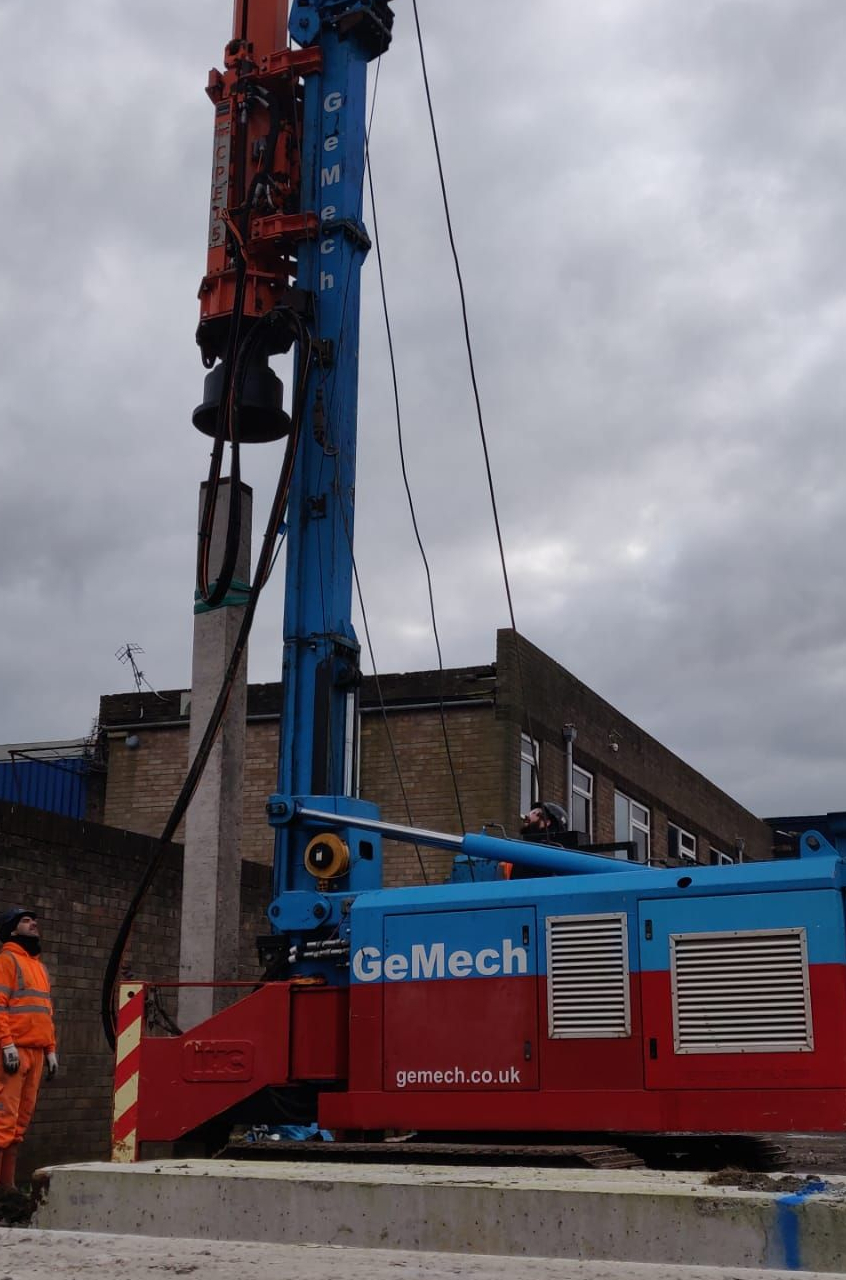
The recent adaption to our Vermeer HL2500 allowed GeMech to provide a driven precast concrete pile solution on this site in Weston-Super-Mare, allowing cost savings for the client. 250mm square precast concrete piles were driven to 16.0m depth in to Mercia Mudstone bedrock.










Unit 12 Kenn Court,
South Bristol Business Park,
Roman Farm Rd,
Bristol BS4 1UL,
United Kingdom
Tel: 01173015480
E-mail: info@gemechltd.co.uk
Metro Centre,
28 Dwight Rd, Northwood,
Watford WD18 9SB,
United Kingdom
E-mail: info@gemechltd.co.uk